
Dental billing looks straightforward until you're inside it. A patient comes in, treatment gets delivered, the claim goes out — and then nothing happens for six weeks while the practice waits. Understanding why that happens, and what a disciplined billing process looks like from first contact to final payment, is the difference between a practice that collects 95 cents of every dollar it produces and one that writes off 15 percent every quarter.
This guide walks through every stage of the dental billing cycle — the steps, where money gets lost at each one, and what "done right" actually looks like.
Stage 1: Insurance verification before the appointment.
The billing cycle starts before the patient sets foot in the chair. Insurance eligibility verification — confirming active coverage, benefit limits, frequency limitations, and applicable waiting periods for the planned treatment — is the single most preventable source of claim denials. Most payers deny on technicalities that are visible in the eligibility data days before the appointment.
A complete verification reviews the patient's plan for the specific procedures scheduled: whether a crown benefit resets on a calendar year or a rolling 12 months, whether a waiting period applies to a new enrollee, whether a missing tooth clause will exclude an implant. Collecting a copay estimate at check-in based on unverified benefits creates a billing problem the front desk has to unwind later.
Verification also triggers a compliance step that is easy to overlook: before anyone on a billing team can access a patient's benefit information, a Business Associate Agreement (BAA) must be in place between the practice and the billing vendor. A BAA is a formal HIPAA contract establishing that the vendor handles Protected Health Information (PHI) under the same safeguards the covered entity is required to maintain. Employees of the practice don't require a separate BAA because they operate under the practice's existing HIPAA policies — but any external party touching PHI does. Skipping this step creates regulatory exposure that a denial or audit will surface at the worst possible time.
Stage 2: Treatment coding and claim preparation.
The clinical record becomes a financial document at the coding stage. The treating provider documents the diagnosis and procedures using CDT codes (Current Dental Terminology), and the billing team maps those codes to the correct claim fields — tooth number, surface, supporting narrative where required, and the appropriate date of service.
Coding errors at this stage compound. A missing tooth number on a posterior crown. A periodontal code submitted without the required charting. An FMX bundled with an exam on the same date when the payer separates them. These aren't edge cases — they're the daily texture of dental billing. Each error adds one to three weeks to the collection cycle when the payer returns a request for additional information, and many practices never appeal those that fall past the timely filing deadline.
Most payer information requests are not a genuine need for data — they are a delay tactic. A payer asking how long orthodontic treatment is expected to take, or when Invisalign attachments were placed, already has access to that information through the plan's treatment authorization workflow. The request goes out anyway because it parks the claim until the practice gets around to responding. A billing team that recognizes these patterns responds within 24 to 48 hours rather than letting the claim age into a timely filing problem.
Stage 3: Claim submission and the clearinghouse.
Claims move from the practice management system to a clearinghouse — an intermediary that formats and routes electronic claims to hundreds of payers. The clearinghouse performs a first-pass scrub for formatting errors: missing fields, invalid NPI combinations, codes that aren't covered under the selected plan type. Clean claims pass through; rejected claims bounce back before they ever reach the payer's adjudication queue.
Clearinghouse rejections are not payer denials — they're fixable in hours, not weeks. But a practice that submits weekly instead of daily, or that doesn't monitor its clearinghouse exception queue, lets rejected claims sit until someone notices the payment didn't come. The discipline of same-day submission and daily exception review is what separates a clean AR from one that requires forensic accounting to untangle.
Stage 4: Adjudication and the EOB.
The payer adjudicates the claim — applying the patient's plan rules to determine what is payable — and returns an Explanation of Benefits (EOB) or Electronic Remittance Advice (ERA) detailing the allowed amount, the plan's payment, and any adjustments or denials. This is where most of the revenue cycle either collects or leaks.
A denial on an EOB is not the end of the process — it's the beginning of appeals. Most denials fall into predictable categories: missing information, frequency limitations exceeded, coverage not active on date of service, bundling conflicts. Each category has a specific appeal path. A billing team that knows payer behavior submits the right documentation to the right appeals address on the first attempt rather than cycling through generic reconsiderations that extend timelines by months.
Days — the typical time a denied claim sits before the practice follows up, often after the appeals window has narrowed. Across ZenHub's own client accounts, a denial worked within two weeks has a materially higher overturn rate than one worked at 60 days.
Stage 5: Payment posting and patient balance determination.
When the payer's payment arrives — as an EFT deposit or paper check — the billing team posts it against each claim line and reconciles the payment to the EOB. Accurate payment posting matters because it determines what, if anything, is billed to the patient next.
Some practices collect a patient portion estimate at the time of service, based on the verified plan and expected insurance payment. Even a thorough estimate can leave a small residual balance once the EOB posts — a minor plan adjustment, a deductible contribution that was partially but not fully met, an alternate benefit provision the payer applied. In those cases a balance statement goes to the patient. Other practices choose not to collect at the time of service at all, billing the patient after the insurance pays. Either workflow can be managed cleanly as long as the billing team reconciles payments against the verified estimate rather than guessing.
Stage 6: AR follow-up and aging management.
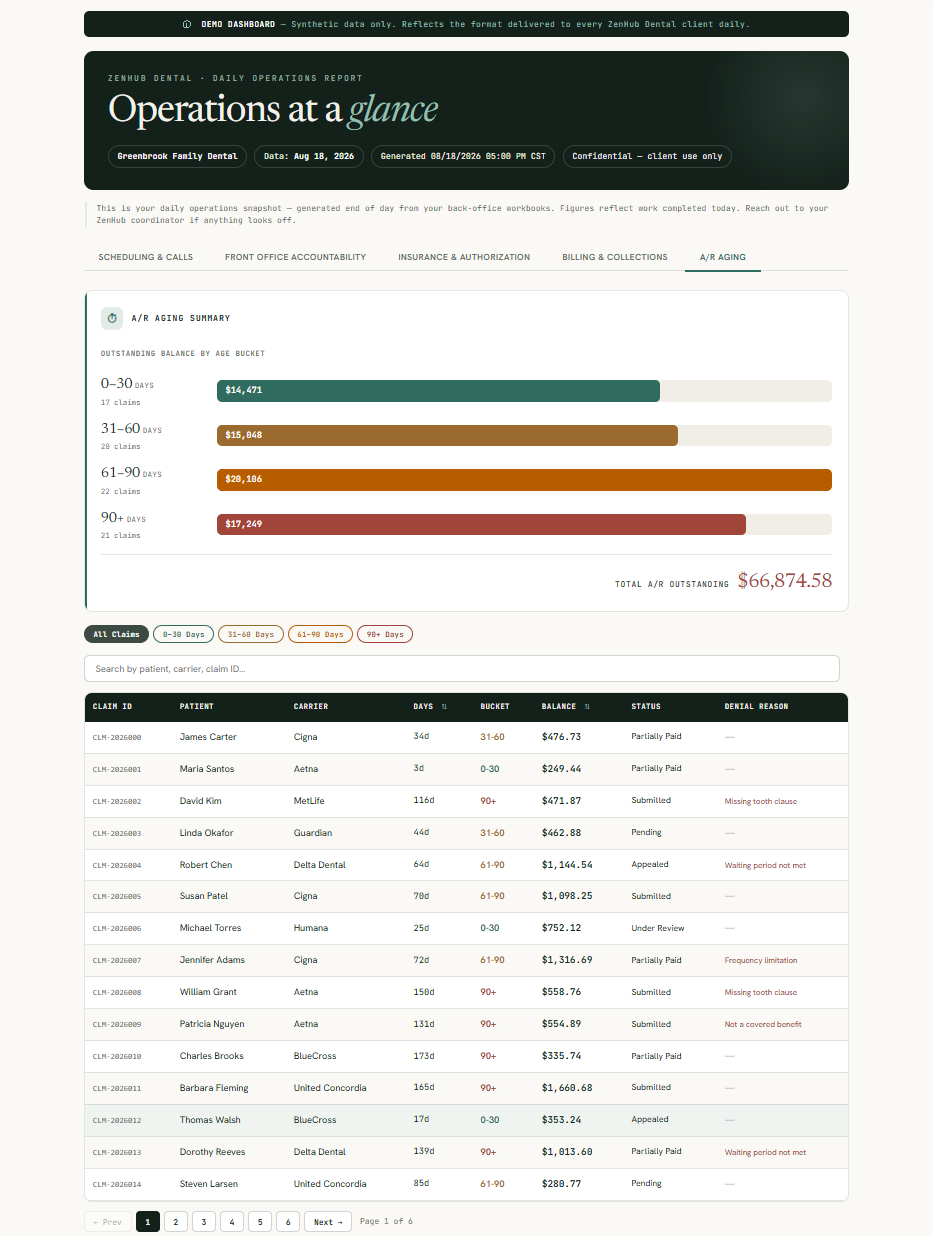
Accounts receivable follow-up is the part of the billing cycle that most practices underfund. Insurance AR that ages past 90 days without action has a sharply lower collection probability — payers narrow their appeals windows, claim data becomes harder to reconstruct, and representatives become less available for real-time resolution calls.
A disciplined AR process works claims by age bucket on a defined schedule: 30-day claims confirm receipt at the payer; 60-day claims get a status call or portal inquiry; 90-day claims trigger a formal appeal if no payment has posted. Claims in the 90-plus bucket get escalated to a supervisor-level contact or, in cases involving repeated systematic underpayment, documented for payer-specific follow-up patterns.
This is what daily reporting makes visible. At ZenHub, every client receives a dashboard updated at the end of each business day — insurance verifications completed, claims submitted, payments posted, denial status, and AR aging by bucket. When a claim crosses into a new aging window without resolution, it surfaces that day. That visibility is the mechanism that keeps the AR from silently growing.
Stage 7: Security, HIPAA, and the infrastructure behind it all.
Every stage of the billing cycle touches PHI — patient names, dates of birth, procedure records, payment data, and insurance identifiers. That scope of data access requires a security posture that matches the obligation.
HIPAA's Security Rule requires covered entities and their business associates to implement administrative, physical, and technical safeguards. On the technical side, that means encrypted data in transit and at rest, multi-factor authentication on every system that can access patient data, role-based access controls so no one sees records they don't have a reason to access, and an audit trail that documents who accessed what and when. We use an enterprise password manager with audit-trail logging across all client systems — no shared credentials, no exceptions — and we require BAAs to be fully executed before any member of our team touches a single record.
This isn't a compliance checkbox. Dental practices that outsource billing are extending their HIPAA liability to a business associate. The question to ask any billing vendor is not whether they're HIPAA-compliant — everyone says they are — but how they enforce access controls day to day and whether they can produce an audit log on request.
Where practices lose the most money.
Across all the stages above, the losses concentrate in a few predictable places: eligibility not verified before the appointment, coding errors that reach the payer instead of being caught in-house, denied claims that age past the appeals window without action, and AR that nobody has time to work because the front desk is managing the schedule and the phone simultaneously. The billing cycle isn't complicated in concept — it's demanding in execution, and it punishes lapses at every stage.
If you're evaluating whether your current billing process is capturing what it should, our in-house vs. outsourced dental billing comparison walks through the loaded cost and coverage risk of each model. Or if you want to see how we structure the work for specific practice types, the RelyOn Smiles case study covers what the first 90 days of a billing engagement looks like and what moved on the AR.